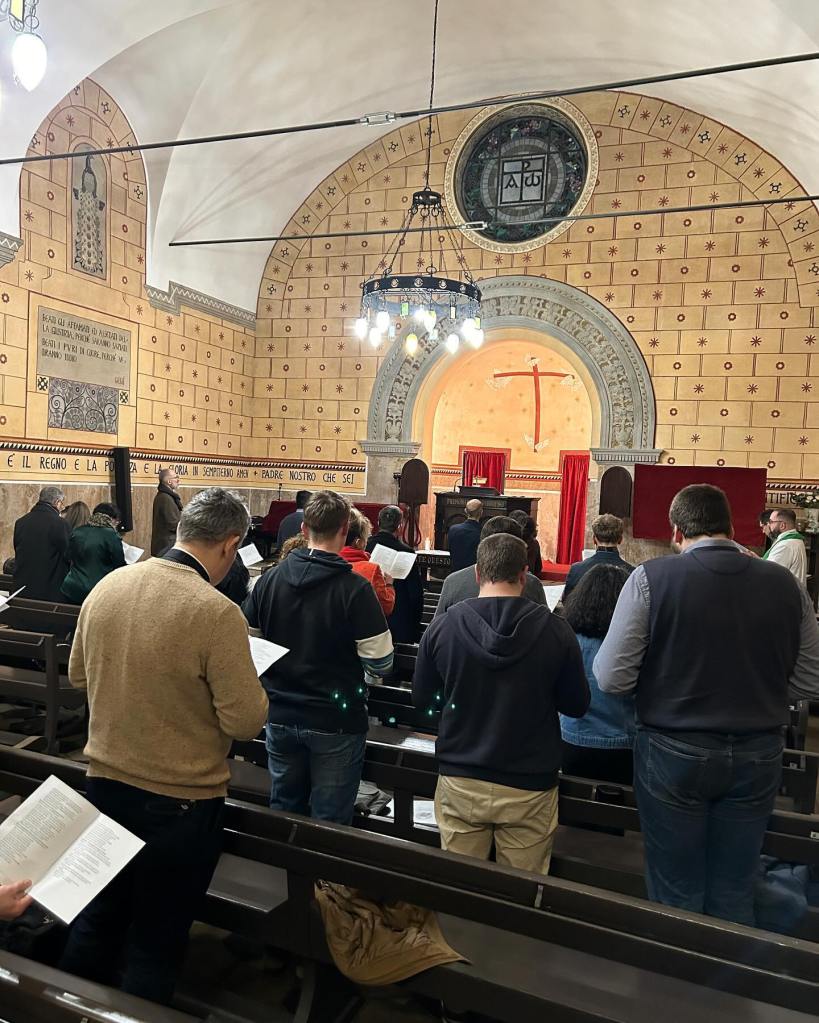
“…and what you have heard from me in the presence of many witnesses entrust to faithful men, who will be able to teach others also” (2 Timothy 2:2). It is not often that we experience history, but last week we were privileged to do just that, attending the dedication and opening Divine Service in the new church home of The Confessional Lutheran Church of Italy—in the very heart of Rome. If Martin Luther had been able to attend, I can imagine that he might have offered a powerful prayer, evoking from Scripture that Jesus Christ alone “is the Lamb of God who takes away the sins of the world”… and “that one is justified by faith apart from the works of the law” (as he declares in his Smalcald Articles). This beautiful Divine Service was the capstone of an outstanding two-day conference entitled “Rome and Justification,” in which five scholars described how, over time, “works righteousness” began seeping into the Early Church. Hundreds of years later it was already deeply rooted in church teaching. Shockingly, by the Council of Trent in 1563, the doctrine of justification—so clearly taught in both the Old and New Testament—was even anathemized. Lutherans from around the world attended the conference, put together by LCMS missionaries Rev. Tyler McMiller (based in Rome) and Rev. Dr. David Preus (based in Brasov, Romania). The symposium also provided an excellent venue to present to potential students Riga Luther Academy, the online seminary in which already some 25 students from 18 countries are enrolled. Considering that Martin Luther was condemned as an outlaw and heretic in 1521, the fact that a church named after him would be inaugurated some 500 years later is nothing short of a miracle. Praise God for this brand-new church and for the fact that—despite almost two millennia of opposition—the true teachings of historic Christianity are once entrusted to faithful men, who are teaching others—beginning with the simple yet central doctrine of justification.