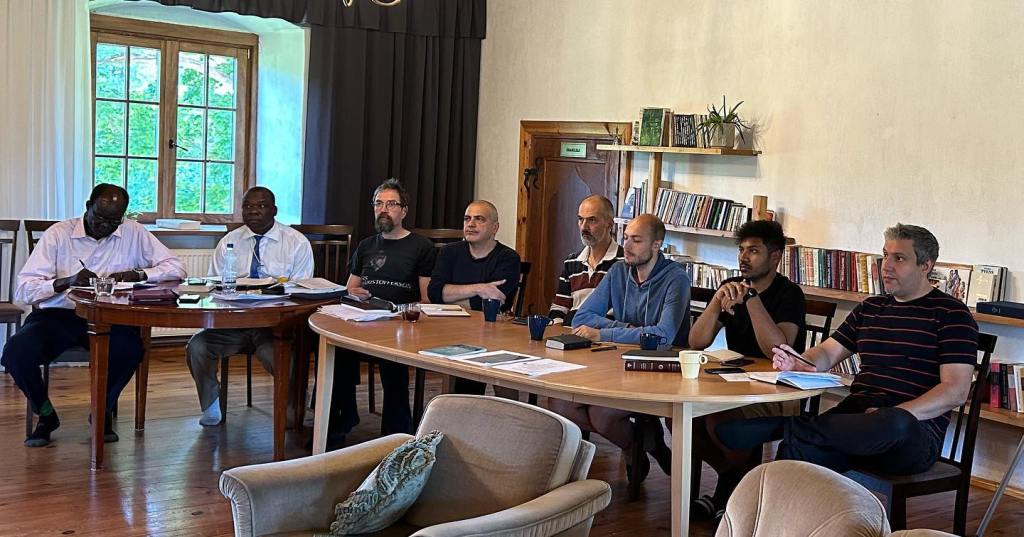
Currently back in Latvia, with the other faculty and seminarians from Eurasia and Africa for Luther Academy’s “Intensive Study Weeks.” Once or twice a year we see our students face-to-face and supplement online instruction with in-person classes. This past semester I taught “Lutheran Confessions of Faith,” in which we worked through the entire Book of Concord—a collection of 16th-century documents that explain correct Christian teaching on various doctrines and expose theological errors introduced by the medieval Church and other groups. I greatly enjoyed the students’ final papers, reading their thoughts on how the Lutheran Confessions interpret Holy Scripture faithfully and serve as a pastor’s most helpful tool for explaining various doctrines. One student had for many years been a priest in a certain Christian denomination. But, praise be to God, at one point he discovered the original teachings of Christianity, studied them, and a few years later was ordained a Lutheran pastor. Now honing his skills at the Academy, he offered a lovely illustration, sharing how his grandfather had always read the newspaper with a magnifying glass. He compared the Book of Concord to that magnifying glass because it amplifies key doctrinal concepts of the Bible and brings them into focus. Indeed, he summarized, “The Book [of Concord] was created through the initiative of a simple Augustinian friar [and other theologians] who detected some deficiencies on the part of the clergy in following the true teaching of Jesus Christ. Thank you,” [Luther Academy”], “for allowing me to write these few lines that also contain my living expression of the Lutheran Faith in which I am growing thanks to the input of many people who contribute to my spiritual and human growth.” Amen. And a prayer of thanksgiving for the many generous donors who make Riga Luther Academy possible, a wonderful institution forming pastors who spread the Gospel all across Eurasia and Africa—faithfully.
 The Tiews in Germany